Most enterprise vulnerability programs were built for a world where defenders had more time.
That assumption is getting weaker. Frontier AI models are beginning to change how quickly vulnerabilities can be found, connected, tested, and potentially exploited. For CISOs and enterprise technology leaders, the issue is not whether every attacker suddenly becomes elite. The issue is whether the organization can reduce risk fast enough when the attacker timeline gets shorter.
Claude Mythos is a useful warning sign because it points to a broader shift already underway. Anthropic described Mythos Preview as a general-purpose model with unusually strong cybersecurity capability. The UK AI Security Institute reported significant improvement in cyber evaluations, including multi-step attack simulations.
Security leaders do not need to panic, but they should not treat this as just another AI headline. The practical lesson is that AI is reducing friction on the offensive side of cyber operations. If your vulnerability program needs weeks to resolve high-risk exposure, AI does not need to be magical to create a problem. It only needs to make the attacker’s side of the timeline shorter.
What Claude Mythos Signals About Slower Defenders
The concern is not that every AI model will autonomously breach hardened enterprises overnight. The more practical concern is that the economics of vulnerability discovery are changing.
Tasks that once required scarce expertise may become easier to scale. Vulnerability research may become faster. Exploit prototyping may become more accessible. Weaknesses buried across code, configurations, dependencies, APIs, cloud services, and identity relationships may become easier to connect.
Many organizations still manage vulnerabilities as a ticketing workflow. A scanner finds an issue. A platform ranks it. A ticket gets opened. A team disputes ownership. A meeting decides priority. A patch waits for a maintenance window. An exception gets approved.
That process can look mature in a dashboard. It can produce reports, metrics, and governance evidence. But it often breaks when the organization needs speed.
The hard truth is that vulnerability management in many enterprises is not limited by tooling. It is limited by decision latency. If ownership, exposure, exploitability, data impact, and emergency authority are not already known, the organization burns time during the risk window.
AI-assisted vulnerability discovery makes that delay more expensive.
Attackers Think in Paths. Enterprises Often Work in Queues
A common mistake is to treat this as a narrow AI security issue. That leads to useful but incomplete questions about model security, prompt leakage, jailbreaks, and AI usage policies.
Those questions matter, but they are not enough. The broader issue is AI-speed cyber risk. That includes the systems AI can help attackers analyze, the data they may target, the identities they may abuse, the cloud services they may pivot through, and the operational delays that give them time.
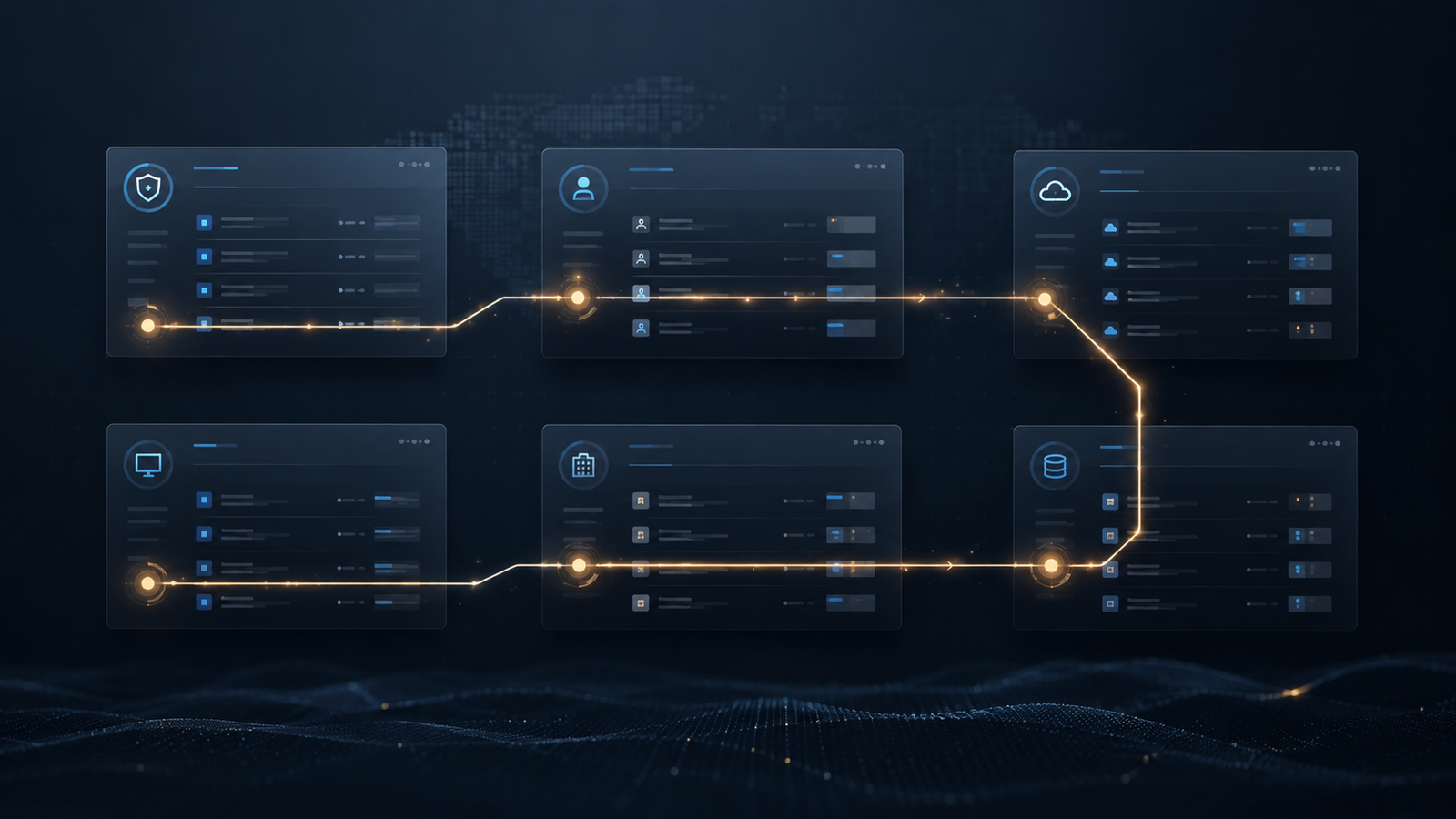
In enterprise environments, attackers rarely think in isolated vulnerabilities. They think in paths. An exposed application leads to a vulnerable service. A vulnerable service leads to a credential. A credential leads to a cloud role. A cloud role leads to sensitive data. Sensitive data leads to business impact.
Inside the enterprise, those same components may belong to five different teams.
The attacker sees a chain. The organization sees separate queues.
That is the gap AI may widen. Severity scores alone will not solve it. A critical vulnerability on an isolated lab system is different from a high-severity weakness on an internet-facing application tied to customer data, privileged access, or revenue operations.
Start With What Creates Business Impact
The starting point is not which vulnerabilities are critical. The starting point is which assets would create material business impact if compromised.
That includes crown-jewel data stores, identity systems, production AI platforms, customer-facing applications, privileged administration paths, payment systems, regulated data environments, source code repositories, and core business platforms.
Many enterprises already have fragments of this view. They may have a CMDB, a data classification policy, a cloud inventory, and architecture diagrams. The problem is that these artifacts are often incomplete, stale, or disconnected from remediation decisions.
A practical crown-jewel view should answer several questions quickly. Which systems matter most? What data do they process? Which identities can access them? Which services are exposed? Which vulnerabilities affect them? Which third parties connect to them? Which controls would slow or stop an attack path?
Without that context, prioritization becomes a debate over scores instead of a decision about business risk.
Exposure Management Must Include AI Systems
Most organizations have more exposure than they can explain quickly. Internet-facing services, cloud misconfigurations, APIs, shadow SaaS, over-permissioned identities, unpatched appliances, legacy applications, third-party integrations, developer environments, and AI tools connected to internal data can all become part of an attack path.
The AI dimension makes this more urgent because enterprises are adding new data flows and trust relationships. A RAG application is not just an AI project. It is a retrieval system with access rules. An AI agent is not just automation. It is an identity with permissions. A security copilot may touch sensitive logs, alerts, tickets, vulnerabilities, architecture details, and incident data.
Security teams need to connect vulnerability data with asset criticality, identity paths, cloud posture, network reachability, data sensitivity, and business ownership. The goal is not more findings. The goal is better decisions.
Measure How Fast Risk Can Actually Be Reduced
Speed is not the same as activity. A team can close thousands of low-value findings and still leave the business exposed. A vulnerability dashboard can improve while the most important attack paths remain open.
CISOs should measure remediation speed where it matters most. How long does it take to identify the owner of a critical exposed asset? How quickly can a high-risk issue on a crown-jewel system be escalated? Where do exceptions accumulate? Which systems depend on quarterly change windows? Can compensating controls be deployed when patching is delayed?
These questions are uncomfortable because they reveal organizational friction. But that friction is now part of the threat model.
In an AI-speed environment, slow ownership is a vulnerability. Slow prioritization is a vulnerability. Slow exception review is a vulnerability. Slow identity cleanup is a vulnerability.
Attackers do not need the enterprise to be careless. They only need the enterprise to be slow in the wrong place.
What Monixity Believes
Mythos AI is a warning shot for enterprise security programs that still depend on slow visibility, slow prioritization, and slow remediation.
The central issue is not only whether attackers use AI. The deeper issue is whether the enterprise can make risk decisions quickly enough when discovery and exploitation accelerate.
AI security is not only model security. It includes data, identity, architecture, governance, monitoring, exposure management, vulnerability response, defensive AI adoption, and incident readiness. Defenders should use AI to improve their own speed, but only with approved tools, clear data rules, human review, logging, access control, and output validation.
Monixity helps enterprises evaluate AI-related cyber risk across data, identity, architecture, governance, exposure management, monitoring, and incident readiness. A focused AI security readiness review can help identify where current controls are strong, where exposure is growing, and where human-speed processes may no longer be enough.
If your organization is adopting AI, building AI-enabled systems, or preparing for AI-assisted threats, now is the right time to assess whether your security program can move as fast as the risk it is expected to manage.